back to overview

Whitepapers

Engineering Momentum - The Lifecycle of a Semiconductor Startup

A semiconductor startup only gets one shot. 
Miss it, and you don’t recover. 

You can’t iterate your way out of mistakes. 
The path from breakthrough technology to scaled revenue is sequential and unforgiving. 

Getting the sequence right is extremely hard. 

In our new whitepaper, imec.xpand partner and co-founder Peter Vanbekbergen breaks down the lifecycle that can take a venture to unicorn valuation.

This summary highlights the key insights, you can view the full whitepaper here.

Building a semiconductor startup requires navigating a uniquely demanding lifecycle that blends scientific maturity, productization discipline, customer validation, and organizational scaling in precisely the right sequence. Unlike software ventures, semiconductor startups cannot shortcut critical stages of technology readiness and industrialization. Their entire journey is characterized by path dependency, irreversible decisions, long iteration cycles, and capital-intensive milestones, which must be orchestrated with exceptional clarity.

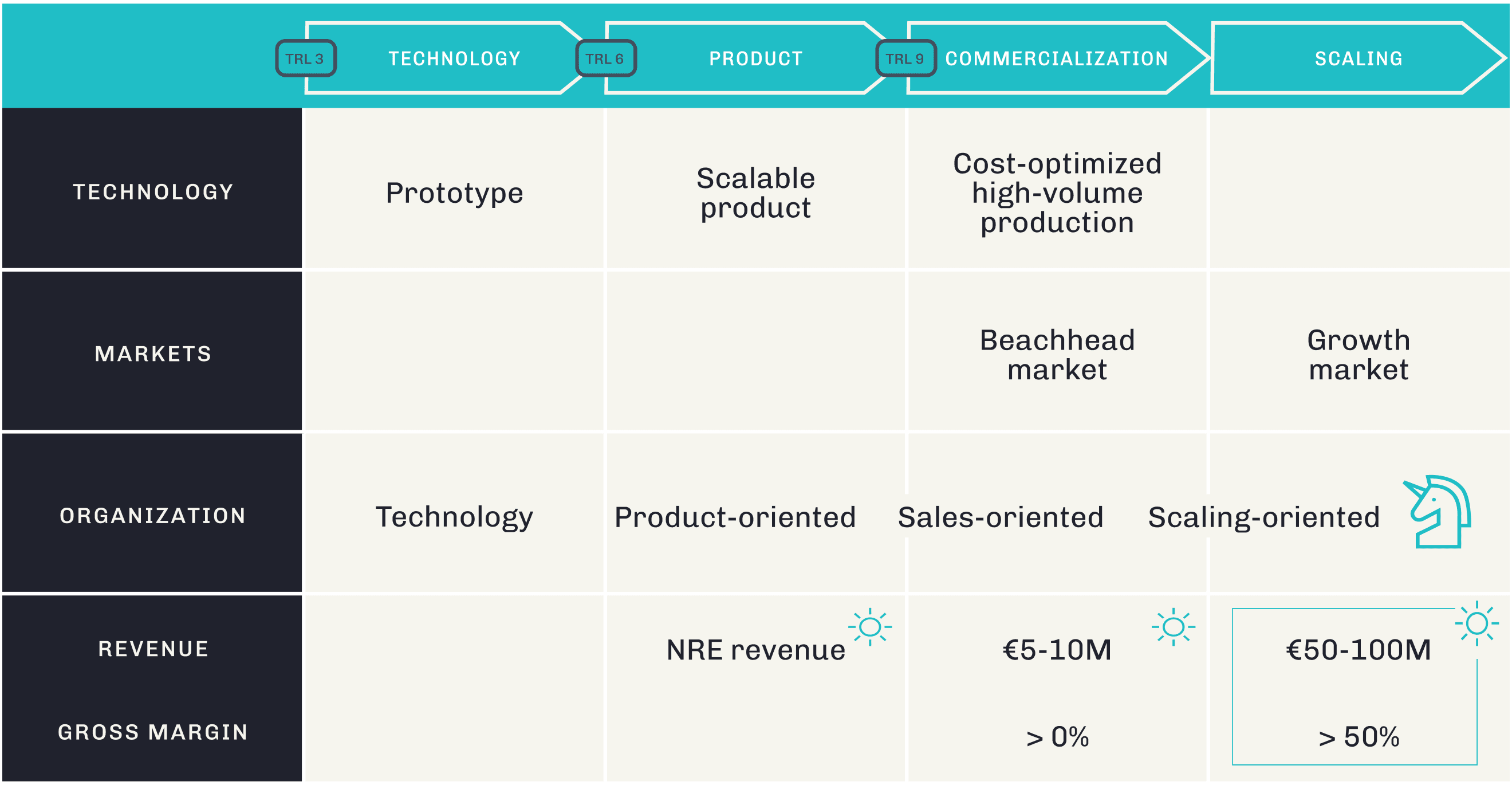
Lifecyle template for semiconductor companies

The figure above outlines a template lifecycle for semiconductor companies, a guideline for how to build a venture toward unicorn valuation level.

Our use of the term lifecycle does not correspond to the life and death of a startup. It refers to the period from Seed to Scale in the evolution of a semiconductor venture — including early technology development, product definition, launch, and early scaling. Throughout this entire timeline, execution must be fast, disciplined, and sequenced, because the consequences of delays are severe. In fact, losing momentum is one of the main reasons semiconductor companies underperform. As it is essential to generate revenue as soon as possible, a company’s focus during this period should be on launching a Minimum Viable Product (MVP) into a carefully selected beachhead market.

The TRL Scale

We identify a yardstick in the Aerospace Technology Readiness Level (TRL) scale and redefine it for our purposes. Translating this scale to the world of semiconductor deep-tech requires shifting from flight-proven milestones to silicon-proven ones. For semiconductors, the difficulty is not the space environment; it is navigating the intricate interdependencies of the design and fabrication process and the subsequent integration into a final system.

Research Phase: TRL 1-2

The fundamental TRL tiers 1 and 2 are considered a purely academic domain, with timelines and uncertainty levels far beyond the typical venture investor’s appetite.

Applied research institutes are fertile breeding grounds for breakthrough semiconductor innovations at this early stage, as they combine the fundamentals of scientific excellence with an industrial partner network and a critical prototyping and testing infrastructure.

Technology Phase: TRL 3-6

The lifecycle of the company usually begins in the technology phase, where a new device concept, materials innovation, MEMS structure, sensor architecture, or packaging approach emerges from the research phase and becomes a candidate for commercialization. At this stage, around TRL 3, experiments show that the idea can work, but it hasn’t yet proven to be repeatable or relevant at the system level. Moving toward TRL 6 is about demonstrating that the innovation is more than an interesting lab result. It needs to hold up across multiple fabrication runs, operate in realistic environments, and show that it can eventually be integrated into a manufacturable flow.

Reaching TRL 6 represents a significant milestone. The technology is now an engineered prototype that behaves consistently enough to support a product concept. However, many founders misunderstand this stage. TRL 6 does not mean the technology is “done”; it means the technology is finally ready to become the foundation of a real product. In reality, productization work is just beginning. At this stage, the team needs to shift from research mode to product mode, because the assumptions that remained implicit in the lab now need to be validated explicitly, in detail, and often in direct conversation with customers.

Although this is early-stage development, the early definition and validation of the MVP already play an essential role. Technology innovations can develop in many different directions and combinations, so it is important to focus specifically on the innovations that are essential to the MVP. This helps meet the template’s stringent deadlines and avoids wasting time on cycles not relevant to the MVP.

Product Phase: TRL 6-9

The second part of a startup’s lifecycle is the product phase, a transformation that moves the company from having a promising technology to having a manufacturable, qualifiable device that satisfies customer requirements. This requires reaching TRL 8, the point at which a product has been validated in its intended operational environment and is supported by a manufacturing process capable of handling predictable volumes.

In TRL 9, which represents the full production operation and market deployment, the company must fully realize its MVP in conjunction with a tightly scoped beachhead market.

The MVP is not a prototype; it is the first product that will be sold, supported, validated by customers, and produced at a quality level sufficient for initial deployment. It should be the simplest product that can both demonstrate clear, customer-relevant value and dominate an early market. Semiconductor MVPs cannot be rushed, but they also cannot be allowed to drift. Every month lost because of unnecessary complexity or unfocused engineering extends the time to revenue and increases dilution.

Reaching TRL 9 involves qualification testing, yield learning, packaging development, firmware and system integration work, and intensive customer feedback cycles. Simultaneously, the organization needs to evolve beyond engineering: It should build early supply chain relationships, establish design-for-manufacturing rigor, and begin developing commercial and operational capabilities.
Commercialization Phase: TRL 9 -> MVP Revenue

When the product reaches TRL 8 (moving to RTL 9) and the MVP is validates, the company enters the commercialization phase. There is absolutely no time to lose at this point, as competitors try to outcompete you, customers need support, and investors expect product revenue. Semiconductor customers never adopt new components lightly. Design-ins and -wins require structured qualification processes, integration pilots, and proof that the supplier can deliver consistent quality and reliable volumes.

The transition from first MVP shipments to recurring revenue is one of the most difficult parts of the entire lifecycle. The company must demonstrate not only that the product works but that it works across customer variants, operational conditions, and the full system in which it will be embedded. Revenues should now move from non-recurring engineering (NRE) agreements to MVP product revenue.

Scaling Phase: Beyond MVP -> Growth Markets

Once early customers have adopted the MVP and revenue becomes repeatable, the startup enters the scaling phase. This is the period when a semiconductor company transitions from selling thousands of units to selling hundreds of thousands or millions, depending on the application. Scaling is about more than simply increasing volume; it is about transforming the startup into a robust industrial organization. Yield improvement, cost optimization, supply chain reliability, and manufacturing resilience become central strategic priorities.

The company must move beyond the beachhead market and into broader growth markets. Expansion cannot begin before the company is operationally ready; premature diversification frequently destroys focus and undermines technical progress. Once the foundation is solid, though, entering adjacent segments allows the company to leverage its technology platform, broaden revenue streams, and position itself for strategic partnerships or acquisition.

Key takeaways

The semiconductor venture lifecycle is shaped by structured, irreversible inflection points. Progression from TRL 3 to TRL 9 includes sequential de-risking of technology, product, market, and scaling dimensions. Each stage demands a different organizational focus and a different type of capital.

Unlike software ventures, semiconductor startups cannot compress or reorder these phases without consequence. The eight-year template - four years to reach a credible MVP and initial revenue, followed by four years to scale - reflects the economic and operational realities of the semiconductor industry. Venture capital aligns naturally with this progression, underwriting successive reductions in risk.

Continuous momentum is required to sustain that alignment. To achieve this and position the company for sustained financing through to profitability, the whole startup team should live and breathe operational excellence during these initial years. An early and well-defined MVP with a corresponding beachhead market will generate a clear focus and facilitate decision-making on the company’s resource allocation.

The semiconductor track is among the most value-generative paths in modern venture capital. The lifecycle must be managed with relentless discipline, but when sequenced correctly, the company can reach unicorn-level valuations.

This summary highlights the key insights of the whitepaper 'Engineering Momentum: The Lifecycle of a Semiconductor Startup'.

You can view the full whitepaper here, including a case study.