back to overview

Whitepapers

Bridging Vision and Early Revenue - MVP and Beachhead Strategy in Semiconductor Startups

Investors say they want two things at once: fast revenue and massive long-term potential.

In semiconductors, the only way to do that is with a real minimum viable product, and a very specific beachhead market, combined with a long-term vision.

In our new whitepaper, imec.xpand partner and co-founder Peter Vanbekbergen explains how to define and develop an MVP, pair it with the right beachhead market, and marry that MVP & beachhead market combination with a clear strategic vision.

This summary highlights the key insights, you can view the full whitepaper here.

The journey from breakthrough technology to a scalable semiconductor company begins with two tightly linked strategic choices. The first is defining the Minimum Viable Product (MVP) in combination with the beachhead market, a specific market segment that a company dominates first to establish a secure, profitable foothold before expanding into larger, adjacent markets. The second is marrying the MVP and paired beachhead market with a clear strategic vision. These choices must be made early, deliberately, and with discipline.

Investor Expectations: Fast Revenue and Huge Markets

Investors are pulled in two strong but opposite directions. On one hand, they want companies that can generate revenue quickly. On the other hand, they expect founders to articulate an ambitious vision that leads to large market opportunities.

This contradiction means a founder must simultaneously:

  • demonstrate a credible path to Technology Readiness Level (TRL) 9 and revenue within a few years,

  • and paint a vision of a big, inspiring, long-term opportunity.

The best way to satisfy both requirements is through a well-chosen MVP paired with a beachhead market and application that enables early market access and product revenue, while clearly mapping how the MVP evolves toward the broader vision. The vision paints an exciting picture of what the company could achieve in the years after the MVP launch; this should represent multibillion-dollar markets, with the potential to be dominated by the startup’s follow-on products.

The company should paint a credible picture of how to get from the MVP to the vision in steps, with each step representing a real product with a real market. We refer to this as the "MVP-to-vision strategy."

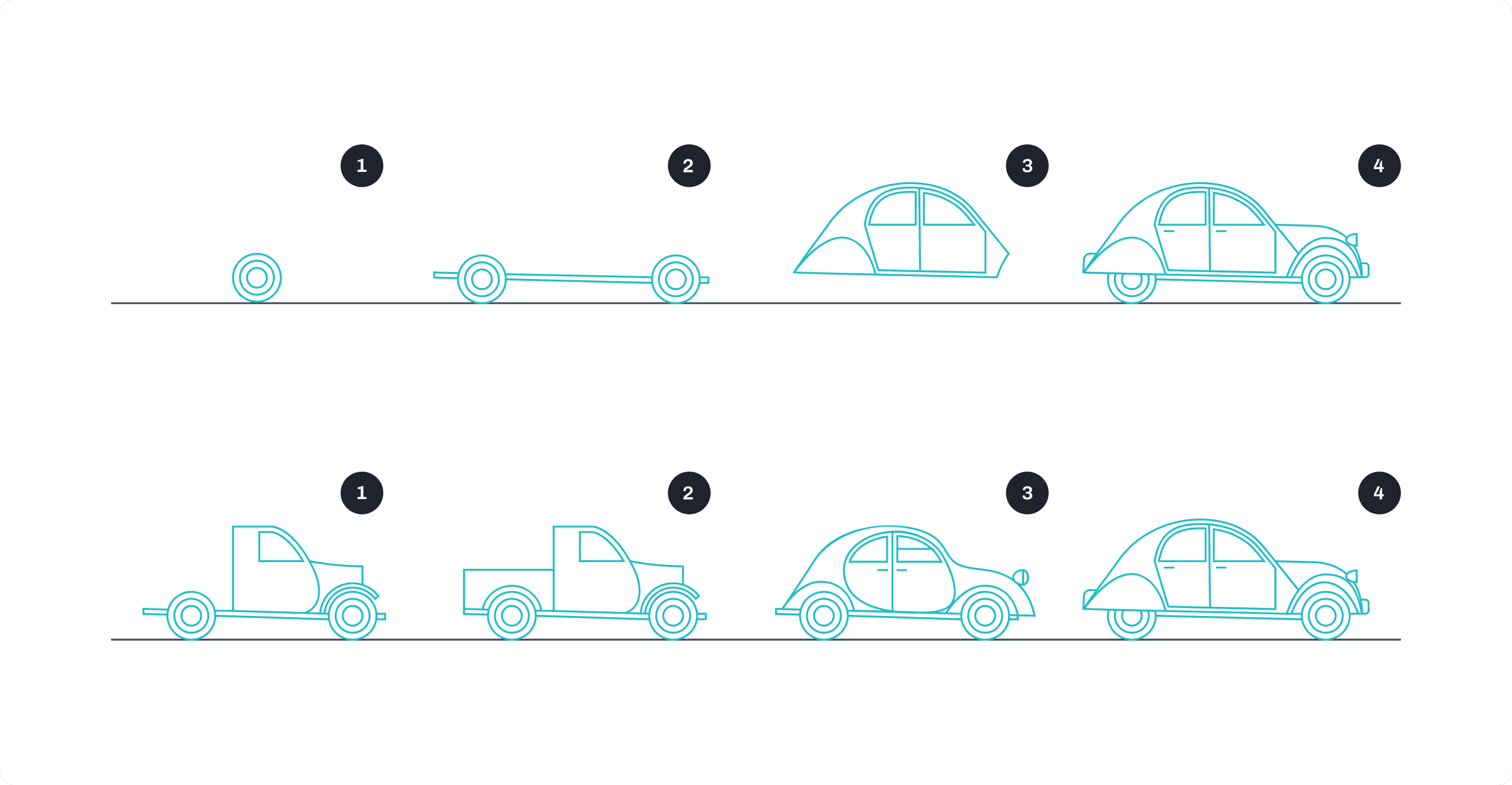
The picture below, although somewhat of an oversimplification, represents this graphically for a long-term vision of selling a fully specified car. Rows 1 and 2 represent distinct approaches, and it is crucial to choose your approach deliberately.

MVP-to-vision strategy

The first row represents incomplete technologies (steps 1-3), with only the final step representing a sellable MVP. With this approach, the startup will only create real product revenue when it reaches step 4. However, at some point along this trajectory, investors and customers may lose patience. Moreover, none of the intermediate steps will ever validate market traction, which is key feedback and necessary to convince investors that it is worth continuing to invest in the product development.

The second row represents a different approach, in which each technology point represents a sellable product, and each product is an upgrade of the previous product in credible, explainable steps. Through this approach, the company can start creating revenue with product 1, with corresponding customer validation.

It is very important to note that approximately 95% of a company’s resources should be focused on the MVP/beachhead definition, validation, and development. The organization’s entire goal is to develop and launch the product and reach product revenue as quickly as possible.

The MVP as a Real Product, not a Prototype

Founders often fail by confusing early technology demonstrations with products. An MVP in a semiconductor business is a real, sellable, scalable product, not a research prototype. Since investors have limited patience waiting for evidence of manufacturability, reliability, and market acceptance, semiconductor startups are expected to reach TRL9 with the MVP within four years.

The MVP must have:

  • product specifications that are validated with customers on the beachhead application;

  • reliable and robust behavior that covers all the customer cases for which the product is intended;

  • support documentation;

  • a manufacturable supply path that can cover production for at least the coming two to three years.

This is why defining the MVP is not a brainstorming exercise to test assumptions but a continuous process of assumption validation, driven by a strong product manager/owner embedded from day one.

MVP + Beachhead Market: A Single, Well-Defined Combination

Semiconductor startups operate under intense resource constraints. For this reason, the MVP and beachhead market must be defined as one tightly integrated pair. The startup team must focus all early sales, marketing, and engineering efforts on one specific application in one segment. Furthermore, the beachhead should have adjacent markets that the startup can enter after having conquered the beachhead.

The term beachhead market comes from military strategy, vividly illustrated by the Allied landings in Normandy on D-Day. In that operation, forces first secured a narrow strip of coastline - a “beachhead” - that served as a defensible foothold in hostile territory. From this initial position, they reinforced troops, stabilized supply lines, and then advanced inland to liberate larger regions.

In business and innovation strategy, a beachhead market follows the same logic: Instead of trying to capture an entire market at once, a company focuses on a small, well-defined segment where it can establish dominance and build momentum. Once firmly positioned in that initial niche, it leverages credibility, resources, and customer traction to expand into adjacent markets, just as the Allied forces expanded from the beaches of Normandy into mainland Europe.

There are several reasons why this focus is essential. First, developing a semiconductor product is an extremely complicated endeavor. It is technologically challenging, has a complex supply chain, and requires strong partnerships and demanding customers.

Furthermore, semiconductor markets are unforgiving. A design-in is a major investment for the customer. They may already have spent years integrating an inferior solution, and switching is risky. Making the “wrong choice” can be career-limiting for an executive.

Finally, competitive incumbents will actively discourage prospective customers.

By dominating a narrow segment in which requirements and behavior are homogeneous, a startup can have a reasonable chance to overcome these frictions.

Once the company proves the MVP in a focused beachhead market, its cost of sales declines, customer trust increases, word of mouth takes hold, and the company gains bargaining power - all factors that accelerate growth.
The MVP-Vision Table: A Clear Strategic Separation

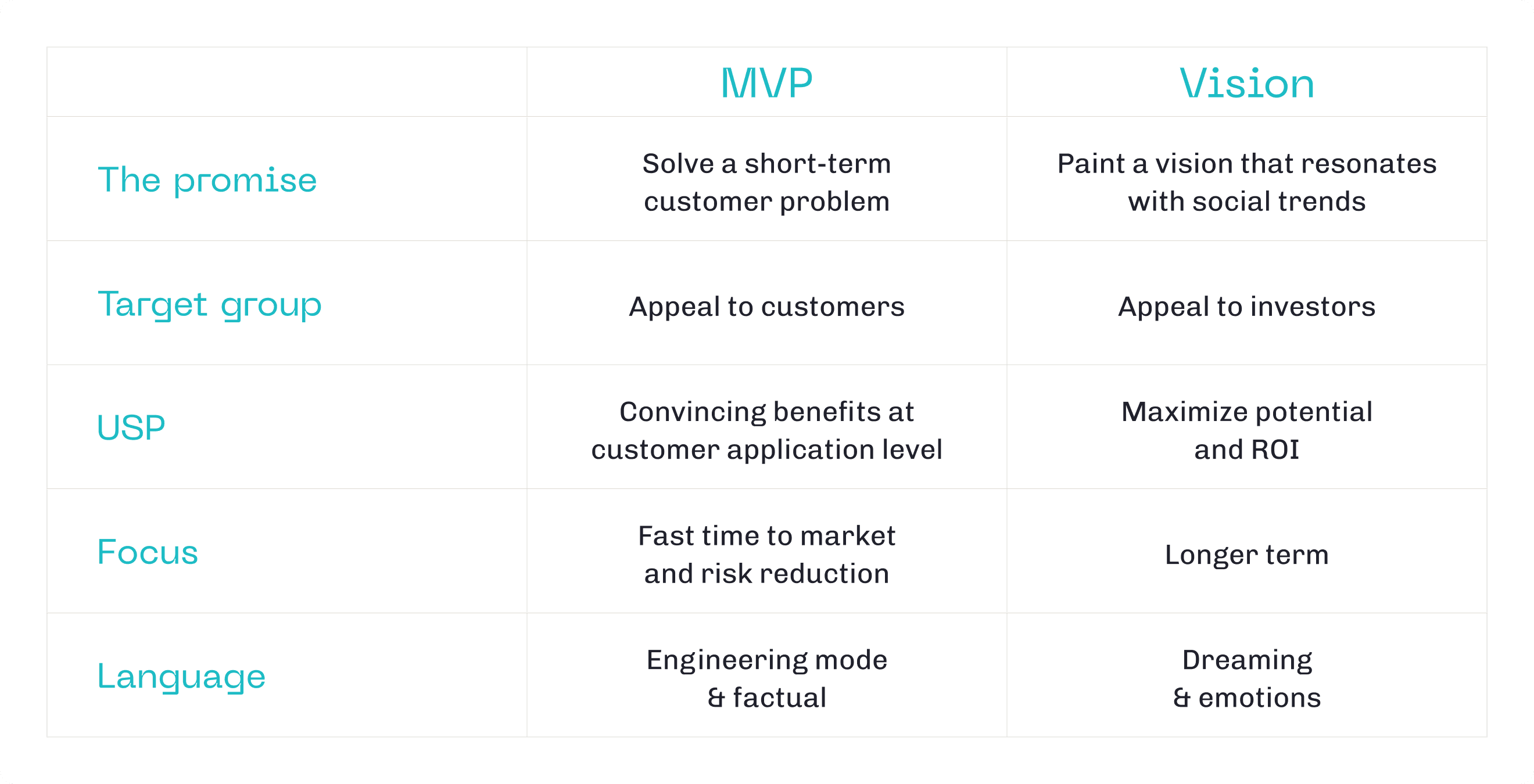
The five-point MVP and vision checklist below shows the difference between the MVP and the long-term vision. This table separates the product initially being built from the company’s targets for the future.

The left side of the table details what the MVP must be: a tightly defined product that solves a concrete customer problem while still reducing risk to enable a fast time-to-market. The right side describes the vision: a far broader scope in line with societal trends, potentially spanning more and bigger markets. The vision allows for dreaming, where it is not clear how all future technological challenges will be solved. This side is less focused on customers but should appeal to investors.

Founders are often lured into trying to build the vision first. That leads to overcomplexity and missed timelines with devastating consequences for the startup. The MVP should be selected not because it is the “ultimate product” but because it is the fastest and most certain path toward proving the company’s value. Every (new) feature in the MVP represents a risk: it may malfunction, delay development time, or introduce unexpected complications. Thus, a company should very consciously decide whether it should take the risk of implementing any new feature (in the MVP) or avoiding it altogether by restricting the beachhead market and application. Avoiding it does not mean that the feature will never be implemented, it is just postponed to a later, more mature version of the MVP.

While it is crucial not to prioritize the vision over the MVP, failing to articulate the vision leaves investors unconvinced of long-term potential. Therefore, combining the MVP and vision consistently is the way to go.

The MVP-Vision  Table

What Makes the MVP Strong Enough to Dominate the Beachhead

We have identified five defining properties of an MVP that is capable of dominating the beachhead market. These properties ensure that the MVP is not merely a functional product but also a commercially viable one.

A true customer-centered 10x improvement

This is not a technological 10×, but a 10× in a functionality the customer cares about most. Most often, these are not specific analytical properties or capabilities of the product, but rather the true value the product offers at the application level. When looking for this customer-centric 10×, look out for customers expressing strong, urgent pain points, and brainstorm ways an MVP could resolve them decisively.

A defendable moat

This ensures that once the startup wins, competitors cannot easily copy or replace the product. The moat may come from IP, system architecture, manufacturing know-how, or device integration.

Low technological risk

The MVP must increase the predictability of development. Founders are warned that engineers tend to add bells and whistles that create risk and delay. If complexity creeps in, it is often better to narrow the beachhead application rather than expand the MVP functionality.

Scalable production within two to three years

Since scaling from low to mid volume takes at least 18 months, the MVP must allow the company to serve early demand without having to redesign the product or its supply chain.

Early revenue potential

The MVP should be able to generate about €10M/year in revenue in the beachhead market, within one to two years of launch. Of course, this is just a ballpark figure. The key is that the MVP is a real, recurring, revenue-generating product instead of non-recurring engineering revenue.

A good beachhead is often in the range of €100-300M - not massive but substantial. If the market is larger, the startup cannot dominate it early; if it is smaller, the opportunity is insufficient for investors.

We note that financial VCs more often than not balk at such small beachhead markets. However, we find this concept essential. The startup must pick an “entry battle” it can surely win.

MVP Definition and Validation

Developing a semiconductor product takes years. As such, the product validation techniques of Eric Ries’ “The Lean Startup” cannot be applied to most cases of semiconductor development. Fast, two-week iterations based on software prototypes that are continuously improved through customer feedback are not possible here. Thus, there is an enormous danger of leaving customer assumptions unvalidated.

However, every unvalidated assumption is a massive risk multiplier. All company creativity should go into validating assumptions with prospective customers as early as possible.

Companies should:

  • document every detail of the product definition and application use cases (that make up the beachhead market);

  • validate these detailed documents with prospective customers;

  • ensure that the product’s customer use and benefits are well understood and validated with the customer;

  • establish a documented system-level view, including components delivered by the customers and/or partners;

  • use creativity to validate assumptions the best way possible when a full prototype is not available;

  • exercise caution regarding evaluation kits - Although they can be useful tools, they do not usually validate product constraints and assumptions, and the number of EVKs sold does not necessarily reflect customer interest and assumption validation;

  • build an early milestone into the road map that, if an important aspect of the product cannot be validated, allows that particular aspect/assumption to be validated in a better way. It is better to find out earlier - rather than at product launch - that a wrong assumption was made.

Validation shouldn’t be a one-off exercise. Markets evolve while a chip is still in development, and sometimes, assumptions made at the start of development may lose validity after a year or two. Therefore, validation must be continuous.

The bottom line is that if a go-to-market fails because of a wrong assumption that could have been validated early, the company may fail where it could have succeeded by catching that incorrect assumption early. This is a potentially company-destroying mistake.

Why MVP Launches Fail

Based on our experience, these are the three major causes of MVP launch failure along a timeline that spans technology ► product ► commercialization ► scaling:

The MVP is not minimal

Too many features, too much customization, or chasing too many markets simultaneously.

The MVP is not a product

Teams confuse prototypes with products; reliability, documentation, and manufacturability are insufficient or even absent.

The MVP is not viable

The company has not validated customer needs, has misunderstood willingness to pay, or cannot support integration. Alternatively, the product is not unique enough to dominate the beachhead market, as there are enough other viable options for the customer.

All three failure modes push out the timeline, delaying revenue and destabilizing the company. Avoiding these failures requires tight scoping, rigorous customer engagement, and continuous evidence gathering.

This summary highlights the key insights of the whitepaper 'Bridging Vision and Early Revenue - MVP and Beachhead Strategy in Semiconductor Startups'.

You can view the full whitepaper here, including examples and a case study.